SPONDYLOSIS
Word parts:
- spondylo- (Greek spondylos, “vertebra”)
- -osis (Greek suffix denoting “condition, process”)
Definition:
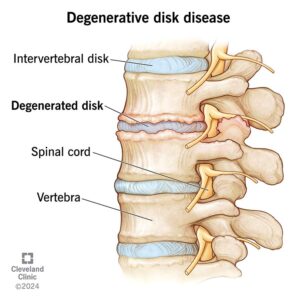
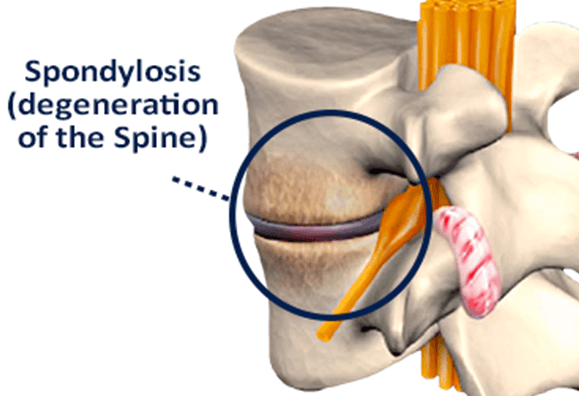
A general term referring to age-related structural changes of the spine, encompassing findings such as disk height loss and desiccation, facet joint degeneration, and osteophyte (bone spur) formation. Rather than describing one specific structural finding, “spondylosis” functions as a broad, umbrella term, and by itself does not specify which particular structure is primarily involved, or to what degree.
Spondylosis increases with age, and is frequently identified incidentally on imaging in people without any symptoms at all. Dr. Phillips believes spondylosis is a valuable term precisely because it describes the expected structural changes of an aging spine without pathologizing them — it is not a disease process or a specific diagnosis, but a description of what is visually different from a fully matured, non-degenerated baseline state. As with other structural findings throughout this glossary, its presence on imaging does not by itself confirm it as the source of a patient’s symptoms — correlation with clinical exam findings is required. When the term appears on a report, it is often more useful to identify which specific, individually named finding (e.g., facet arthropathy, disk bulge, foraminal narrowing) is actually contributing to a patient’s presentation, rather than relying on “spondylosis” alone.
Source:
This entry, in close to the wording above, appears in Dorland’s Illustrated Medical Dictionary and Stedman’s Medical Dictionary under “spondylosis.”