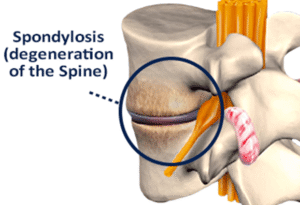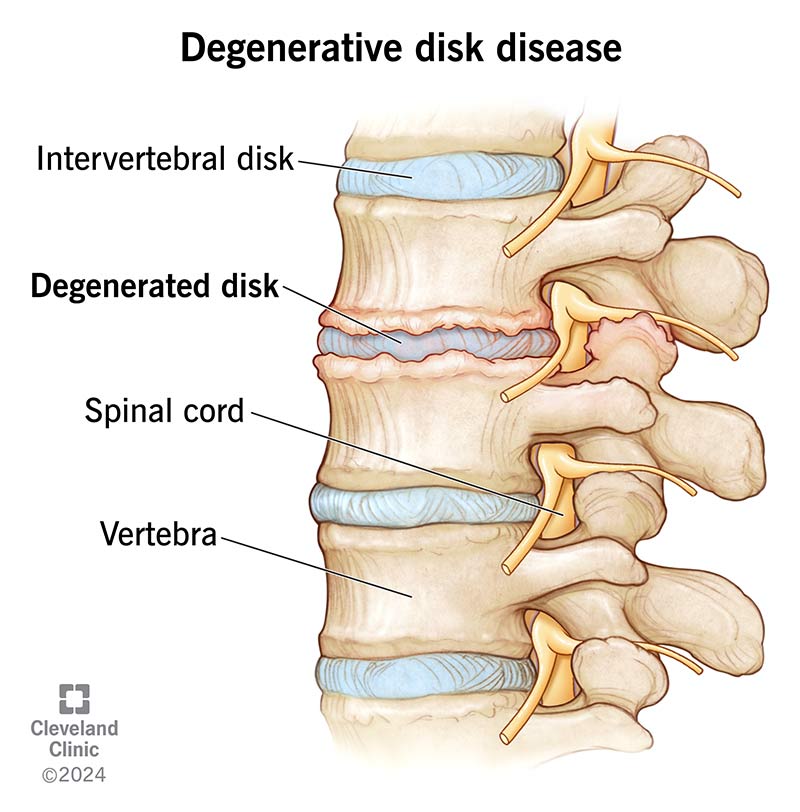
DEGENERATIVE DISC DISEASE
Definition:
Despite its name, degenerative disc disease is not truly a “disease” in the sense of a distinct pathological process — it more accurately describes the normal, expected progression of age-related disk changes (including loss of water content, decreased disk height, and disk bulging) that occurs with aging, and is present to some degree in nearly everyone by middle age. The term did not appear in Stedman’s Medical Dictionary (27th Edition); it was added in later editions once it had become common medical shorthand, despite not originating as a formally defined clinical term.
Degenerative disc disease is frequently identified incidentally on imaging in people without any symptoms at all, and its presence does not by itself confirm it as the source of a patient’s symptoms — correlation with clinical exam findings is required. Much like “sciatica,” covered elsewhere in this glossary, it is a term that conveys only a vague, general impression rather than a specific structural finding — it is not descriptive of any particular level, structure, or degree of change.
Dr. Phillips considers this term not just unhelpful but potentially harmful: by pairing the word “disease” with a normal, near-universal age-related process, it can lead patients to believe something is fundamentally wrong with them, fueling unnecessary fear, worry, and, at times, a search for interventions aimed at “treating” what is actually expected aging. Dr. Phillips thinks we should stop using this term altogether.
Source:
This entry, in close to the wording above, appears in Dorland’s Illustrated Medical Dictionary under “degenerative disk disease.”